At the core of this project is the belief that research expands when we allow ourselves to step into uncertainty; when we witness what emerges, shifts, recombines, or escapes our methods of observing. Whether in physics, performance, or pluriversal inquiry, the work asks how we might hold complexity together, and cultivate shared meanings without reducing the intricacies of different systems of reference.
This approach seeks knowledge as something generated through interaction, through the shared capacity to affect and be affected—to remain porous to the world, attuned to the forces and relations that shape it.
May our explorations inspire awe and reimagine time as a more fluid, malleable, and inclusive dimension of reality. And in honoring this responsibility, as Rebecca Elson reminds us, let us not forget to ask questions while we venture into the sharp starlight.
Other initiatives where you can find me : https://yonderartscience.com | https://nbi.ku.dk/english/research/astrophysics/dark/ | Forening Oasis [website in the making]
This is my rich text.
This is more rich text.
I am a list
Lists are cool
Performance is a world-generation practice that allows for the interplay of our perceptions and relations. In my artistic practice, performance becomes a research on how we inhabit and co-create meaning. Embodiment becomes another channel of inquiry. In this search for knowledge—this need for portals of wonder through which shared imaginaries can be recombined—embodiment offers generative ground. Performance opens temporary co-habitations that unsettle habitual perceptions. In the images above, from a performance at the Stork Fountain in Copenhagen, passersby became collaborators in transforming the site; the landscape shifted, and with it our relations to it. Such moments invite the “otherwise”, imagination, play, and experimentation with the realities we think we inhabit.
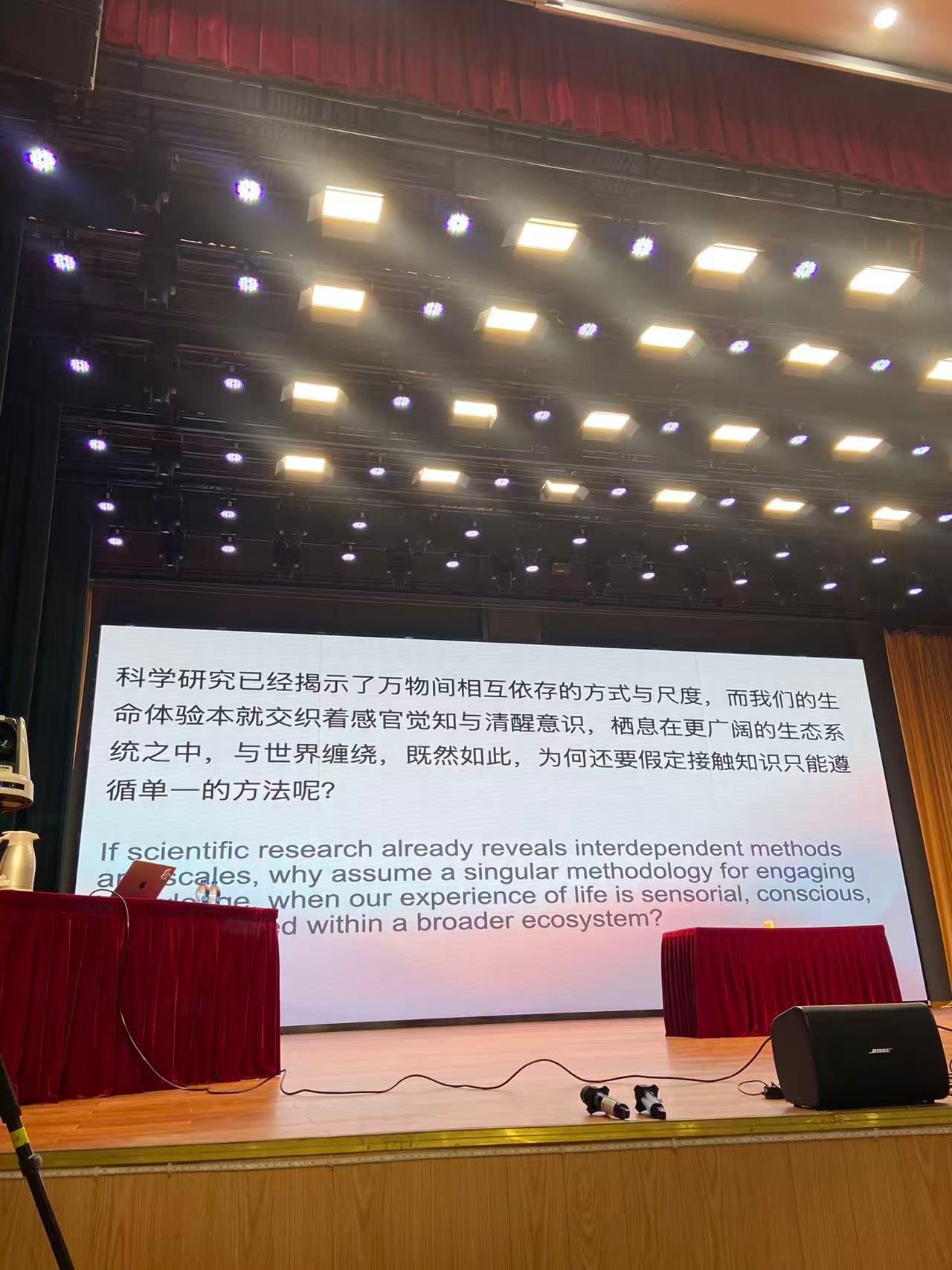
Pluriversality expands and confronts the way we listen. It is a decolonial approach to epistemology and ontology that challenges the idea of a single world, a single method, a single way of knowing. Instead, it insists on the power of diversity and on confronting how our institutions determine what counts as knowledge.
Heisenberg reminds us that “what we observe is not nature itself, but nature exposed to our method of questioning.” If this is the case, then part of the work is the courage and tenderness required to examine those methods, especially when they reveal what is uncomfortable, strange, or historically discriminatory.
Pluriversal approaches draw on global epistemologies and practices that hold time, temporalities, memory, and futures differently — not with the aim of replacing one worldview with another, but in shared affection distanced from dualities. These include performative, poetic, ritualistic, and community-rooted forms of knowledge as in Gloria Anzaldúa’s imaginative bodily flights; revitalizations of archives; and reflections on erasure and nonlinear temporalities, like Olufemi’s experiments for the otherwise. Thinkers like Rasheedah Phillips and Audre Lorde remind us that knowledge is shaped through cultural experience and embodied feeling, while Haraway’s situated knowledges emphasize partiality, relation, and accountability. Together, they reject objectivity as detachment and frame understanding as a transformative and political act.
The study of entropy and the so-called arrow of time begins by revisiting the foundations of thermodynamics and statistical mechanics, and how these frameworks define the properties and evolution of physical systems. This research examines entropy through these theoretical frameworks while questioning the assumptions embedded in the approximations that underlie them.
Our current scientific understanding of time largely relies on reductionist, metric frameworks rooted in classical thermodynamics and Newtonian physics. However, examples across different scales—from nanoscale molecular dynamics to self-gravitating systems—challenge many of the commonly used methods. This project therefore revisits statistical mechanics in regimes involving small particle numbers and long-range gravitational interactions, investigating how equilibrium and temporal directionality emerge—or fail to emerge—in self-organizing systems. By attending to the subtleties within these regimes, concepts often treated as stable begin to shift, revealing the limits of our standard approximations.
More broadly, this work explores how the arrow of time may depend not only on physical processes but also on scale and observation. It raises the possibility that the temporal asymmetry we experience is shaped in part by memory and perception, while the quantum nature of physical systems allows for fluctuations that may include local or temporary reversals. Whether such fluctuations occur but remain inaccessible to human perception is an open question motivating this investigation.